Why Avignon?
In 1305, the newly elected Pope Clement V — a Frenchman — found Rome ungovernable, torn apart by feuding noble families. He never made it to the city. Instead, after a peripatetic papacy moving between French towns, his successor John XXII settled permanently in Avignon in 1316. The city belonged to the papacy's vassal, the Kingdom of Naples, making it technically independent of France — a political convenience that suited everyone.
Building the Palace
Construction began in earnest under Pope Benedict XII from 1334, who demolished the old bishop's palace and raised in its place the Old Palace — austere, fortress-like, a monument to Cistercian severity. His successor Clement VI, a man of entirely different temperament, added the New Palace between 1342 and 1352: grander, more ornate, filled with frescoes by the Sienese painter Matteo Giovannetti, and befitting a pope who famously declared that "a pontiff must give generously."
Scale & Power
The completed palace covers some 15,000 square metres across two main structures. Its walls reach 50 metres in height; its towers are visible for miles across the Rhône valley. At its height it housed not just the pope but an entire bureaucratic city: the papal chancery, the treasury, the law courts, stables, kitchens capable of feeding thousands, and the private apartments of the most powerful man in Christendom.
The Schism
When Pope Gregory XI returned the papacy to Rome in 1377, the relief in Rome was immense — but the peace did not last. On his death in 1378 the cardinals, pressured by a Roman mob, elected an Italian pope. Then, reconvening in safety, they declared the election void and elected a French pope, who returned to Avignon. For nearly forty years, Christendom had two — and briefly three — simultaneous popes, each excommunicating the other's followers. This Great Schism fractured the Church and planted seeds of doubt that would eventually flower into the Reformation.
Revolution & Ruin
After the Schism was resolved at the Council of Constance in 1417, the Avignon papacy faded. The palace became a residence for papal legates, then a prison, then — during the French Revolution — a barracks and a jail. Revolutionary soldiers stripped its frescoes, burned its furniture, and used its grand halls to stable horses. By the time the French state took it over in the 19th century, the interior was largely bare — a magnificent shell.
UNESCO & Today
In 1995, the Palais des Papes and the historic centre of Avignon were inscribed as a UNESCO World Heritage Site. Today it is one of the most visited medieval monuments in Europe, receiving some 650,000 visitors a year. Ongoing restoration work continues to reveal fragments of the original frescoes beneath centuries of grime and whitewash. Each summer, the Grand Courtyard hosts the centrepiece performances of the Festival d'Avignon, founded in 1947 — one of the world's great theatre festivals.
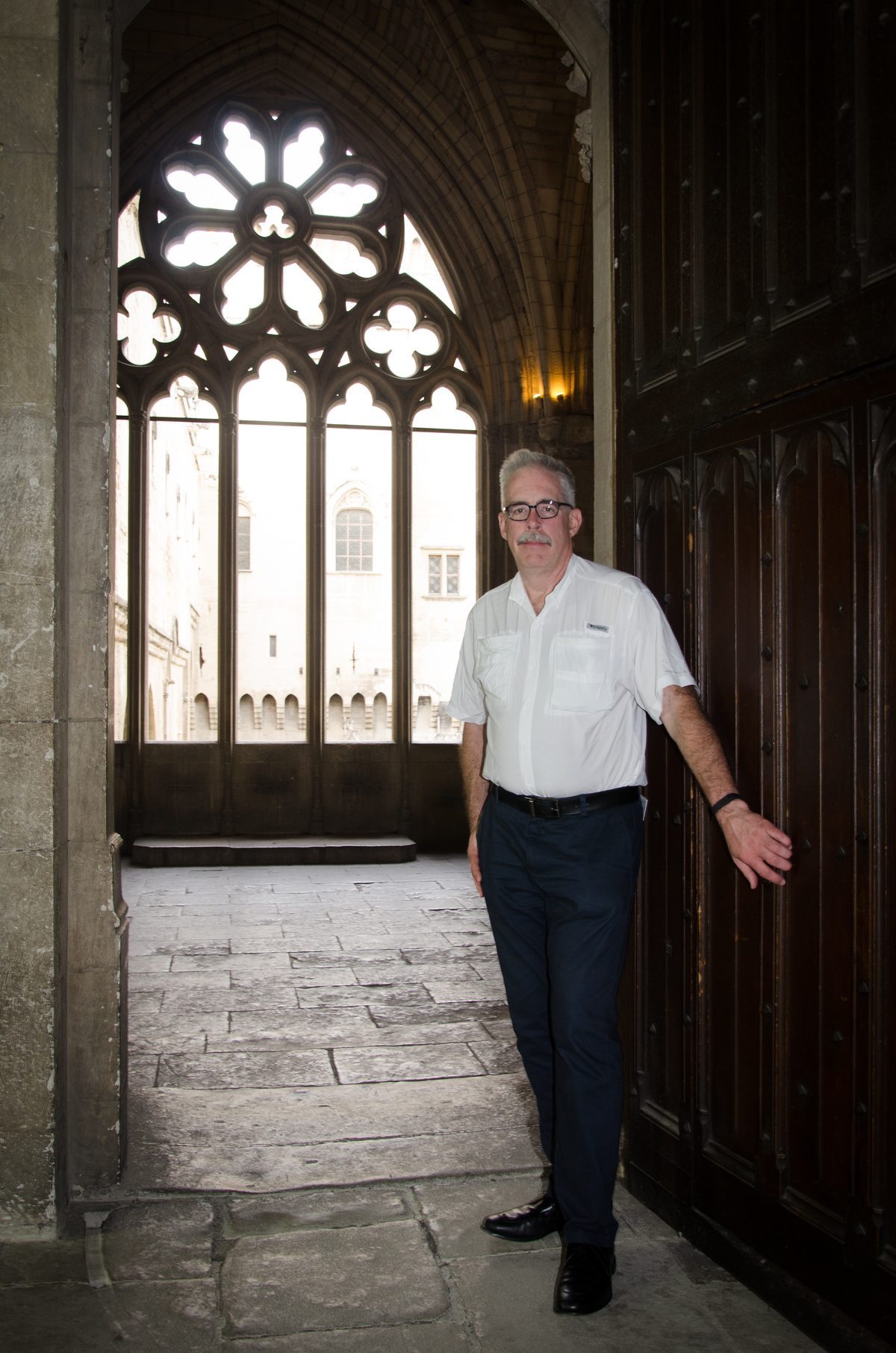
The Gothic tracery visible through the archway in this photograph belongs to one of the palace's interior windows overlooking the Grand Courtyard — the Cour d'Honneur. That rose window pattern, with its interlocking trefoils and lancets, is characteristic of the Rayonnant Gothic style that spread outward from the Île-de-France in the 13th century, carried south by the architects and master masons who followed the papal court. To stand in its shadow is to stand inside one of the supreme achievements of medieval European construction.
What is remarkable about the Palais des Papes is not merely its size — though its size is staggering — but the speed of its construction. The bulk of the complex was raised in less than thirty years, between the 1330s and the 1360s. This required an organisation of labour, materials, and capital that had no precedent in medieval France outside of cathedral building, and in several respects surpassed it. Limestone was quarried from the hills above Avignon; timber came down the Rhône from the forests of Burgundy; lead for the roofs was imported from England. The papal treasury, swollen by the revenues of the universal Church, could afford what no secular prince in Europe could match.
The oak doors visible in this photograph — dark, massive, iron-studded — are among the best-preserved original fittings remaining in the palace. Most of the furnishings were destroyed or removed over the centuries of neglect that followed the return of the papacy to Rome. But the doors endured, as doors often do: too heavy to move, too solid to burn, too large to ignore. They open, as doors in this part of the world have always opened, onto centuries of accumulated human story.
To travel is, in part, to place oneself inside other people's histories — to walk through the rooms where decisions were made that still reverberate. The Palais des Papes is one of those rare places where the scale of what happened here is still legible in the stones themselves: in the height of the towers, the thickness of the walls, the ambition of the windows. It asks you, simply by existing, to take seriously the world that made it.